Tech & Innovation4 mins read
AI and Video Analytics: The Future of Traffic Data Collection
Moving from manual tally sheets to computer-vision traffic intelligence.
By Aurelion Traffic Solutions
Introduction
For decades, traffic data collection relied heavily on manual tally sheets, pneumatic road tubes, and manual video playback—methods that were labor-intensive, prone to human error, and limited in scope. Today, as urban transport networks grow increasingly complex, static counting methods can no longer keep pace.
The integration of artificial intelligence (AI), computer vision, and video analytics is transforming traffic data collection from a slow, sample-based exercise into a high-precision, continuous intelligence stream.
From Manual Tallies to Computer-Vision Intelligence
Traditional counting methods provided basic volume figures, but they often missed critical context such as exact vehicle trajectories, near-miss conflict events, or precise queue build-ups. AI-powered video analytics changes this paradigm entirely:
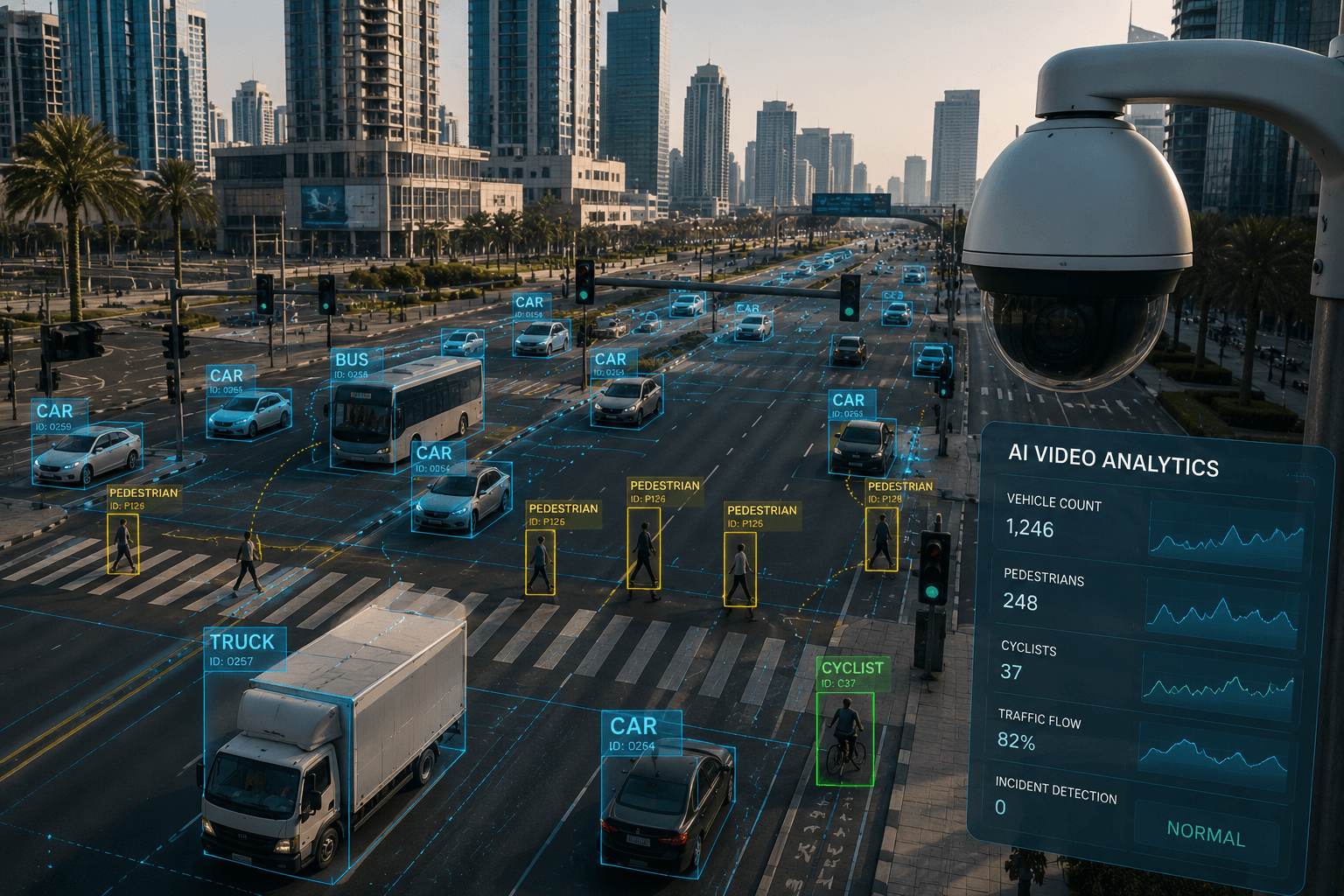
- Automated Multi-Class Counting: Computer-vision algorithms automatically detect, classify, and count multi-modal traffic—distinguishing between sedans, SUVs, heavy goods vehicles (HGVs), buses, motorcycles, bicycles, and pedestrians with over 95%+ accuracy.
- Complex Turning Movement Counts (TMCs): Machine-learning models track movement paths through complex multi-lane junctions and roundabouts, generating complete turning movement matrices automatically.
- Drone Aerial Surveys: Unmanned aerial vehicles (UAVs) paired with AI software capture bird's-eye video over entire corridors, tracking macro-level traffic dynamics and weaving behavior that ground-based cameras cannot catch.
Key Applications Transforming Transportation Engineering
1. Real-Time Queue Length & Delay Analysis
By tracking vehicle positions frame-by-frame, AI video analytics measures exact queue lengths, shockwave propagation, and delay times at signalized intersections. This granular spatial data replaces estimated queue formulas with empirical evidence, enabling precise calibration of microsimulation models in PTV VISSIM or Synchro.
2. Proactive Road Safety & Conflict Detection (SSAM)
Rather than waiting for crash history to identify dangerous locations, computer vision identifies "near-misses" and surrogate safety indicators in real time:
- Time-to-Collision (TTC): Measuring the time remaining before two vehicles would collide if their speeds and trajectories remain unchanged.
- Post-Encroachment Time (PET): Calculating the time gap between a departing vehicle and an encroaching vehicle at a conflict point.
- Pedestrian Interaction Risk: Identifying unsafe jaywalking paths or vehicle-pedestrian conflicts at un-signalized crossings.
3. Origin-Destination & Speed Profiling
By recognizing anonymized vehicle tracks across multiple camera viewpoints, AI engines extract corridor travel times, origin-destination (O-D) routing preferences, and spot speed distributions without violating individual privacy regulations.
The Engineering Advantage: Better Data, Better Models
In transportation engineering, a model is only as reliable as the data used to calibrate it. Leveraging AI-driven video analytics delivers three clear advantages:
- Unmatched Accuracy & Auditability: Verifiable video footage combined with automated verification logs eliminates human counting fatigue and manual data entry errors.
- Speed & Scalability: Processing hundreds of hours of multi-camera footage in hours rather than weeks, dramatically accelerating project timelines and authority submittals.
- Data-Rich Authority Submissions: Supplying municipal and transport authorities (such as RTA, ITC, or MOMRAH) with heatmaps, trajectory plots, and automated video proof builds instant credibility and streamlines approval cycles.
Conclusion
AI and video analytics have elevated traffic data collection from simple volume counting to comprehensive spatial intelligence. By harnessing computer vision and drone surveys, engineers and planners can design safer, more efficient transport networks backed by undeniable empirical evidence.