Traffic Modelling
What If You Could See Tomorrow's Traffic Today?
How Traffic Modelling & Simulation Are Transforming Transportation Engineering
By Aurelion Traffic Solutions
Part 1: Seeing the Future Before It's Built
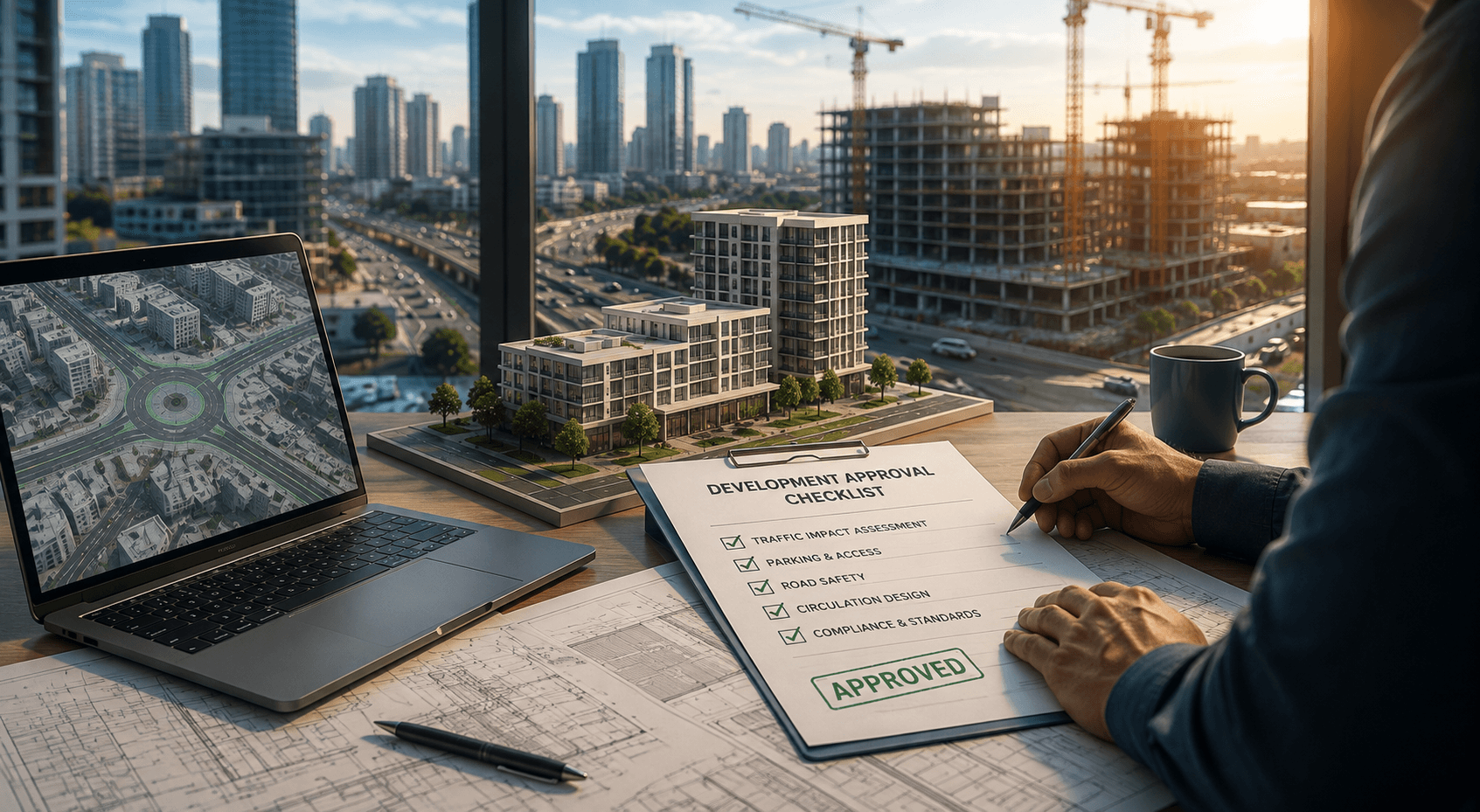
Imagine standing on an empty plot of land where a new mixed-use development is planned. There are no roads, no buildings, no vehicles, and no pedestrians.
Now imagine being able to answer questions such as:
- Will the surrounding junctions cope with future traffic demand?
- Will queues extend beyond nearby intersections during peak hours?
- Is the proposed access arrangement efficient?
- How will emergency vehicles enter the site?
- Will additional traffic signals be required?
- Is the parking layout sufficient?
- What happens if the development doubles in size over the next ten years?
Traditionally, many of these questions could only be answered after construction had begun—or worse, after the development became operational. Today, transportation engineers can answer them before a single road is built.
This is the power of Traffic Modelling and Simulation.
Far more than software or digital visualisations, traffic modelling is one of the most valuable decision-making tools available to transportation planners, engineers, governments, and developers. It allows future transport conditions to be analysed, alternative designs to be tested, and infrastructure investments to be validated before significant resources are committed.
In an era where cities are growing faster than ever and transportation systems are becoming increasingly complex, the ability to predict future mobility has become an essential part of modern infrastructure planning.
Why Predicting Traffic Matters
Every transportation project is designed to serve the future—not the present.
A new residential community may take five years to complete. A metro extension may remain operational for fifty years. A highway upgrade could influence regional mobility for decades.
If engineering decisions are based solely on today's traffic conditions, infrastructure quickly becomes outdated.
This is why transport professionals focus on understanding not only how traffic moves today, but how it will behave tomorrow.
Traffic modelling helps answer critical questions before construction begins:
- Can the road network support future demand?
- Which intersections will become bottlenecks?
- Will signal timings remain effective?
- How will new developments influence nearby communities?
- What infrastructure improvements provide the greatest benefit?
- Which investment delivers the best long-term value?
Instead of relying on assumptions, engineers use evidence-based models to evaluate future scenarios with confidence.
The result is better planning, lower project risk, and infrastructure that continues to perform as cities evolve.
What Is Traffic Modelling?
Traffic modelling is the process of creating a digital representation of a transportation network to understand how vehicles, pedestrians, cyclists, and public transport move under different conditions.
Using traffic surveys, travel demand forecasts, road geometry, signal timings, land-use information, and engineering principles, transportation professionals develop models that replicate real-world traffic behaviour as accurately as possible.
For example, engineers can test:
- A new signalised intersection
- An additional turning lane
- A revised access arrangement
- A proposed shopping centre
- A future residential community
- A road widening project
- A new metro station
- A temporary road closure
- A major sporting event
Each scenario can be evaluated long before construction begins, allowing planners to compare alternatives and select the most effective solution.
Traffic modelling therefore becomes a virtual testing environment for transportation infrastructure.
From Analysis to Better Decisions
One of the greatest misconceptions about traffic modelling is that it simply produces attractive animations. In reality, the animation is only the visible outcome. The real value lies in the engineering insights generated behind the scenes.
A well-developed model enables transportation professionals to measure:
- Network capacity
- Vehicle delays
- Queue lengths
- Travel times
- Level of Service
- Traffic distribution
- Corridor performance
- Public transport interactions
- Pedestrian conflicts
- Future operational resilience
Instead of asking, "Will this design work?", engineers can ask a far more valuable question: "Which design performs best over the next twenty years?" That distinction changes the quality of every transportation decision.
More Than Just Cars
Modern traffic models no longer focus exclusively on vehicle movement. Today's transportation systems are increasingly multimodal.
Successful models now consider:
- Private vehicles
- Public buses
- Metro systems
- Freight traffic
- Cyclists
- Pedestrians
- Ride-sharing services
- School transport
- Emergency vehicles
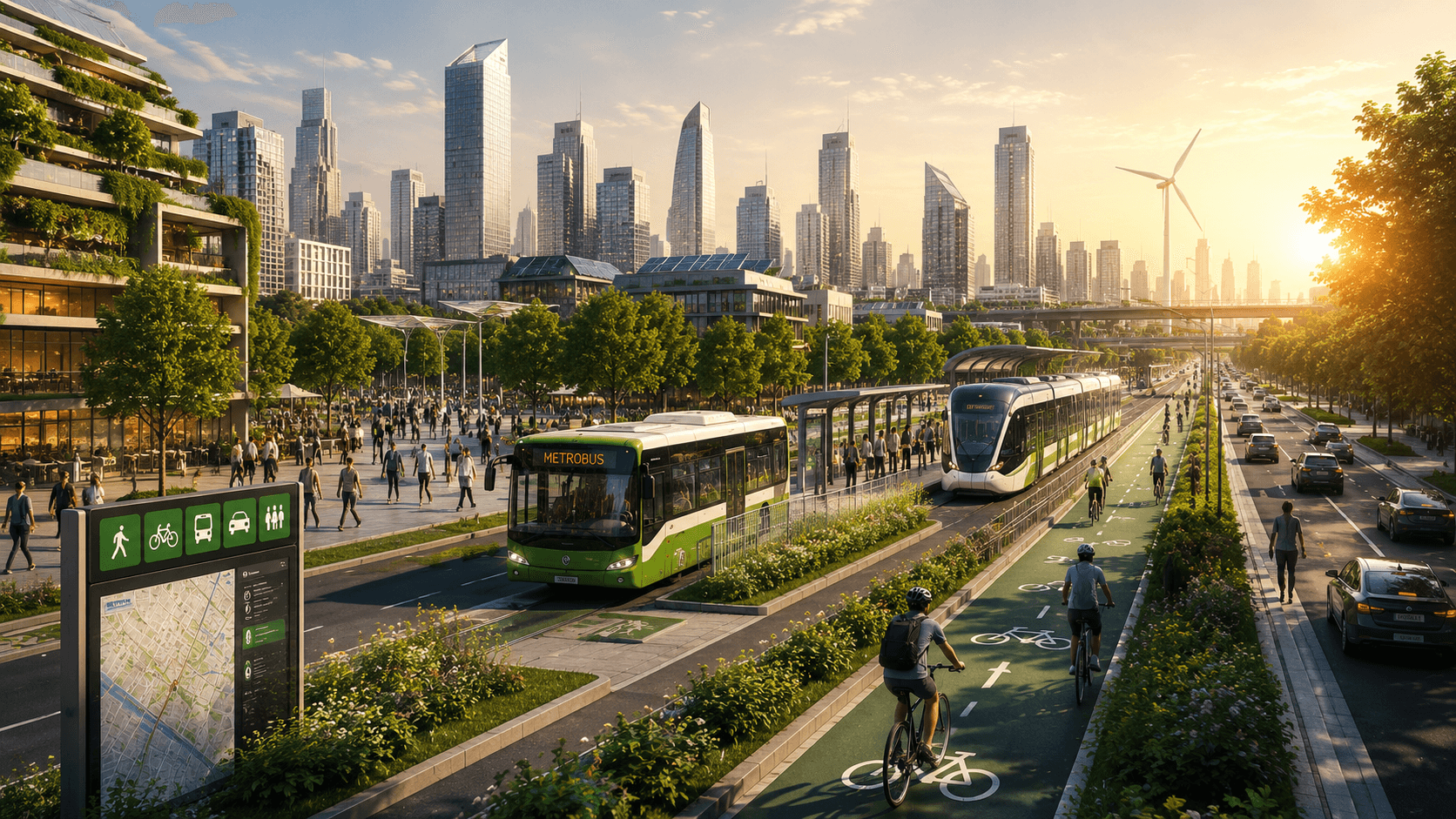
By representing the complete transport ecosystem rather than isolated road traffic, modern modelling helps cities create infrastructure that serves every road user—not just motorists.
Part 2: The Science Behind Predicting Traffic
Every successful transportation project begins with a simple question: "What will happen when this project is complete?"
These are not questions that can be answered through experience alone. They require engineering analysis supported by advanced modelling techniques capable of predicting how transportation systems will perform under future conditions.
Understanding Different Types of Traffic Models
Not every transportation project requires the same level of analysis. The type of model selected depends on the project's objectives, scale, complexity, and the decisions that need to be supported.
Strategic Transport Models
Strategic models provide a high-level understanding of how people travel across an entire city or region. They help answer questions such as:
- Where will future growth occur?
- Which transport corridors require investment?
- How will a new metro line influence travel demand?
- What happens if population increases by 30%?
- Which infrastructure projects should be prioritised?
These models are particularly valuable for governments, transport authorities, and master planners responsible for long-term infrastructure planning.
Operational Traffic Models
Operational models examine how individual road networks function under normal traffic conditions. Engineers evaluate:
- Junction capacity
- Traffic signals
- Lane utilisation
- Vehicle delays
- Queue formation
- Road hierarchy
- Corridor performance
This level of analysis supports detailed engineering design and allows planners to optimise road layouts before construction begins.
Microsimulation Models
Microsimulation represents the highest level of traffic modelling. Rather than analysing traffic as a continuous flow, microsimulation models the behaviour of individual vehicles.
Every vehicle accelerates. Every driver reacts differently. Every lane change is simulated. Every traffic signal influences movement. Every interaction between vehicles contributes to the overall performance of the network.
This creates an extremely realistic representation of future traffic conditions. For complex urban developments, major intersections, airports, logistics centres, or large mixed-use communities, microsimulation provides an invaluable level of confidence before construction begins.
Turning Data Into Engineering Intelligence
Every reliable traffic model begins with understanding how the transportation network performs today. Typical datasets include:
- Turning Movement Counts
- Automatic Traffic Counts
- Queue Length Surveys
- Journey Time Surveys
- Parking Occupancy Surveys
- Pedestrian Counts
- Cyclist Counts
- Public Transport Usage
- Signal Timings
- Road Geometry
- Land Use Information
This information forms the foundation of every model. Once validated, it allows engineers to recreate existing traffic conditions with a high degree of accuracy. Only then can future scenarios be evaluated with confidence.
This process is known as model calibration and validation, and it is one of the most important stages of traffic modelling. A model that does not accurately represent today's conditions cannot reliably predict tomorrow's.
The Software Behind Modern Transportation Engineering
Today's engineers have access to powerful analytical platforms capable of evaluating complex transportation systems.
PTV VISSIM
PTV VISSIM is one of the world's leading microsimulation platforms. It models individual vehicle movements with remarkable accuracy, making it ideal for evaluating signalised intersections, urban corridors, public transport operations, complex interchanges, airport access roads, and large mixed-use developments.
PTV VISUM
While VISSIM focuses on detailed vehicle interactions, PTV VISUM operates at a strategic level. It is widely used for regional transport planning, travel demand forecasting, public transport planning, network assignment, infrastructure investment studies, and long-term mobility strategies.
SIDRA Intersection
SIDRA Intersection has become one of the industry's most trusted tools for analysing signalised junctions, roundabouts, priority intersections, lane configurations, capacity, delay, and Level of Service.
The true value of simulation lies not in graphics but in the decisions it supports. A well-developed traffic model allows engineers to compare multiple design options before construction begins, with each option objectively evaluated using measurable performance indicators. The preferred solution is therefore based on evidence—not intuition.
Part 3: From Simulation to Smart Mobility
Today, traffic models are no longer static snapshots of a single point in time. They are evolving into intelligent, data-driven systems capable of learning, adapting, and supporting real-time decision-making.
The question is no longer "What will traffic look like in five years?" Increasingly, it has become "What is happening right now, and what is likely to happen next?"
Artificial Intelligence Is Changing the Way We Understand Traffic
Every day, transportation networks generate enormous amounts of data. Modern AI systems can automatically:
- Classify vehicle types
- Detect pedestrians and cyclists
- Measure traffic volumes
- Estimate queue lengths
- Calculate vehicle speeds
- Identify congestion patterns
- Detect incidents
- Analyse near-miss events
- Monitor work zones
- Track travel behaviour
AI does not replace transportation engineers. It enhances their ability to make better engineering decisions. Instead of spending days processing raw traffic data, engineers can focus on interpreting results, testing solutions, and solving complex mobility challenges.
The Rise of Digital Twins
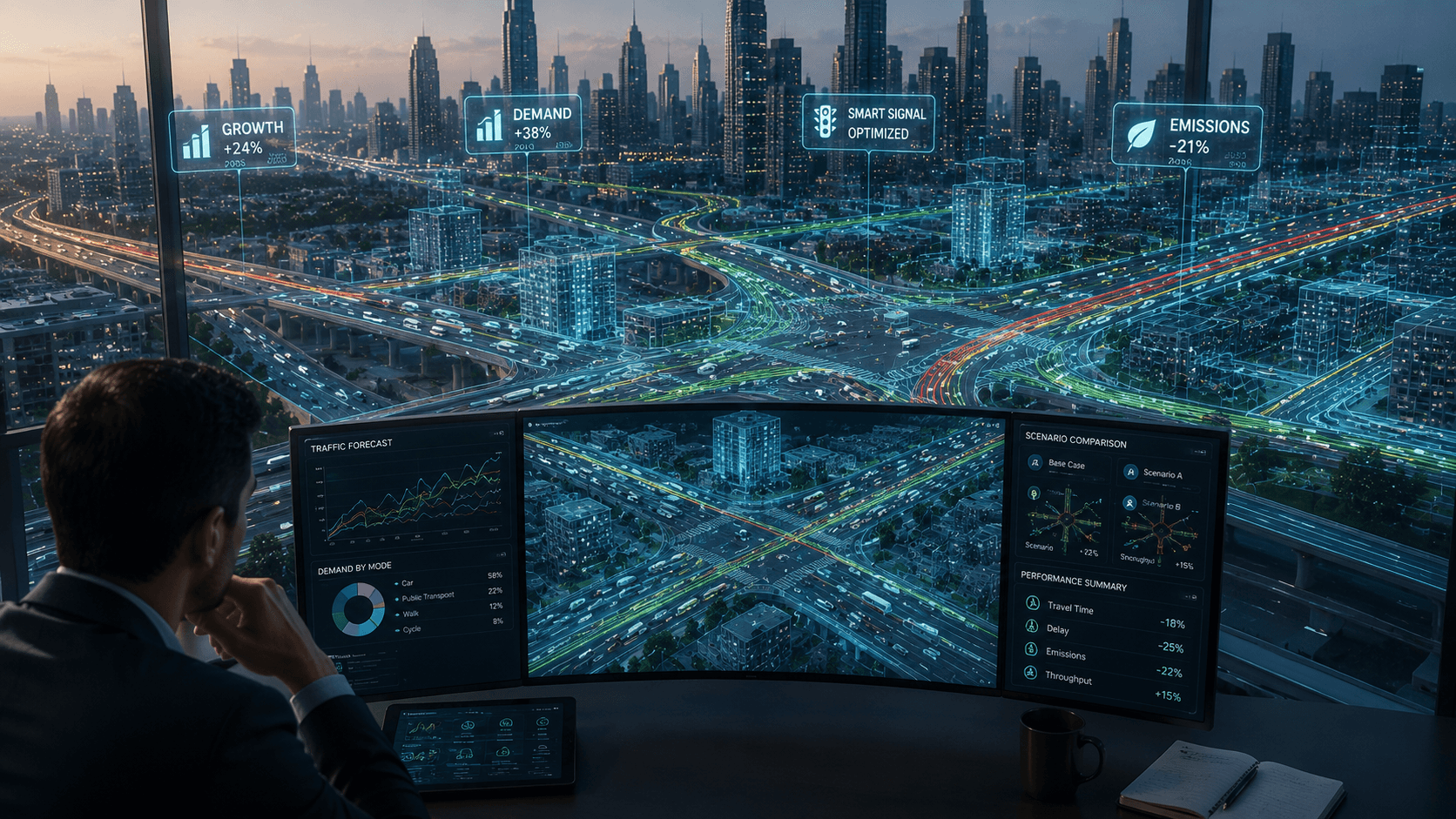
A Digital Twin is a continuously updated digital representation of a real transportation system. Imagine creating a virtual copy of an entire city—every road, traffic signal, intersection, bus route, parking facility, and pedestrian crossing—continuously receiving live information from the physical world.
This enables authorities to evaluate decisions before implementing them in the real world.
Predictive Mobility Instead of Reactive Traffic Management
By combining traffic modelling, artificial intelligence, and continuous data collection, transportation professionals are increasingly able to predict congestion before it develops. Predictive models can identify:
- Future bottlenecks
- Seasonal traffic changes
- Event-related congestion
- Construction impacts
- Public transport disruptions
- Freight movement trends
- Growth-related capacity constraints
This allows authorities and infrastructure operators to introduce operational improvements proactively rather than waiting for problems to escalate.
Smarter Cities Require Smarter Models
Modern traffic models must now represent complex interactions including:
- Intelligent traffic signals
- Connected public transport
- Smart parking systems
- Active mobility infrastructure
- Electric vehicle charging networks
- Shared mobility services
- Freight management platforms
- Urban control centres
A new metro station does more than reduce vehicle trips. It changes pedestrian movement, influences parking demand, alters bus operations, affects taxi activity, changes land values, and encourages higher-density development. Modern traffic modelling captures these complex relationships.
Testing Hundreds of Scenarios Before Construction Begins
For a major urban development, engineers may evaluate dozens—or even hundreds—of alternative scenarios. Examples include:
- Different junction layouts
- Signal timing strategies
- Alternative access locations
- Revised parking configurations
- Public transport priority measures
- Dedicated bus lanes
- Additional pedestrian crossings
- Future development phases
Each option is tested using the same engineering criteria. This allows decisions to be based on measurable performance rather than assumptions or personal preference.
The Future Engineer Will Combine Technology with Judgement
Despite rapid advances in artificial intelligence, machine learning, and predictive analytics, one thing remains unchanged: Engineering judgement is irreplaceable.
Software can process information. AI can identify patterns. Digital Twins can simulate thousands of scenarios. But only experienced transportation engineers can balance competing priorities such as safety, operational efficiency, constructability, sustainability, commercial viability, and long-term community benefit.
Technology provides better information. Engineers transform that information into better decisions.
Part 4: Engineering Better Decisions Before They Become Expensive Problems
Every major infrastructure project begins with a vision. But between vision and reality lies one critical question: Will the transportation system actually perform as intended?
Traffic modelling and simulation help answer that question long before construction begins.
Reducing Risk Before Construction Begins
Every transportation project involves uncertainty. Traffic demand changes. Land uses evolve. Travel behaviour shifts. Population grows. Traffic modelling allows engineers to understand these future scenarios before significant investments are made.
Instead of asking "Will this design work?", clients can ask:
- Which design performs best?
- Which option offers the greatest long-term value?
- Which investment provides the highest return?
- How resilient is the proposed solution?
- Can the infrastructure accommodate future growth?
By answering them early, developers, governments, and infrastructure owners reduce project risk while improving confidence in major investment decisions.
Better Decisions Through Evidence
Traffic modelling strengthens engineering by replacing assumptions with measurable analysis. Performance indicators include:
- Network capacity
- Vehicle delay
- Queue lengths
- Travel times
- Intersection performance
- Corridor efficiency
- Parking utilisation
- Public transport interactions
- Pedestrian accessibility
- Network resilience
When every option is evaluated using the same analytical framework, decision-making becomes more transparent, more collaborative, and significantly more robust.
Supporting Better Cities—Not Just Better Roads
The purpose of traffic modelling extends far beyond improving individual intersections. Well-planned transportation systems influence almost every aspect of urban life.
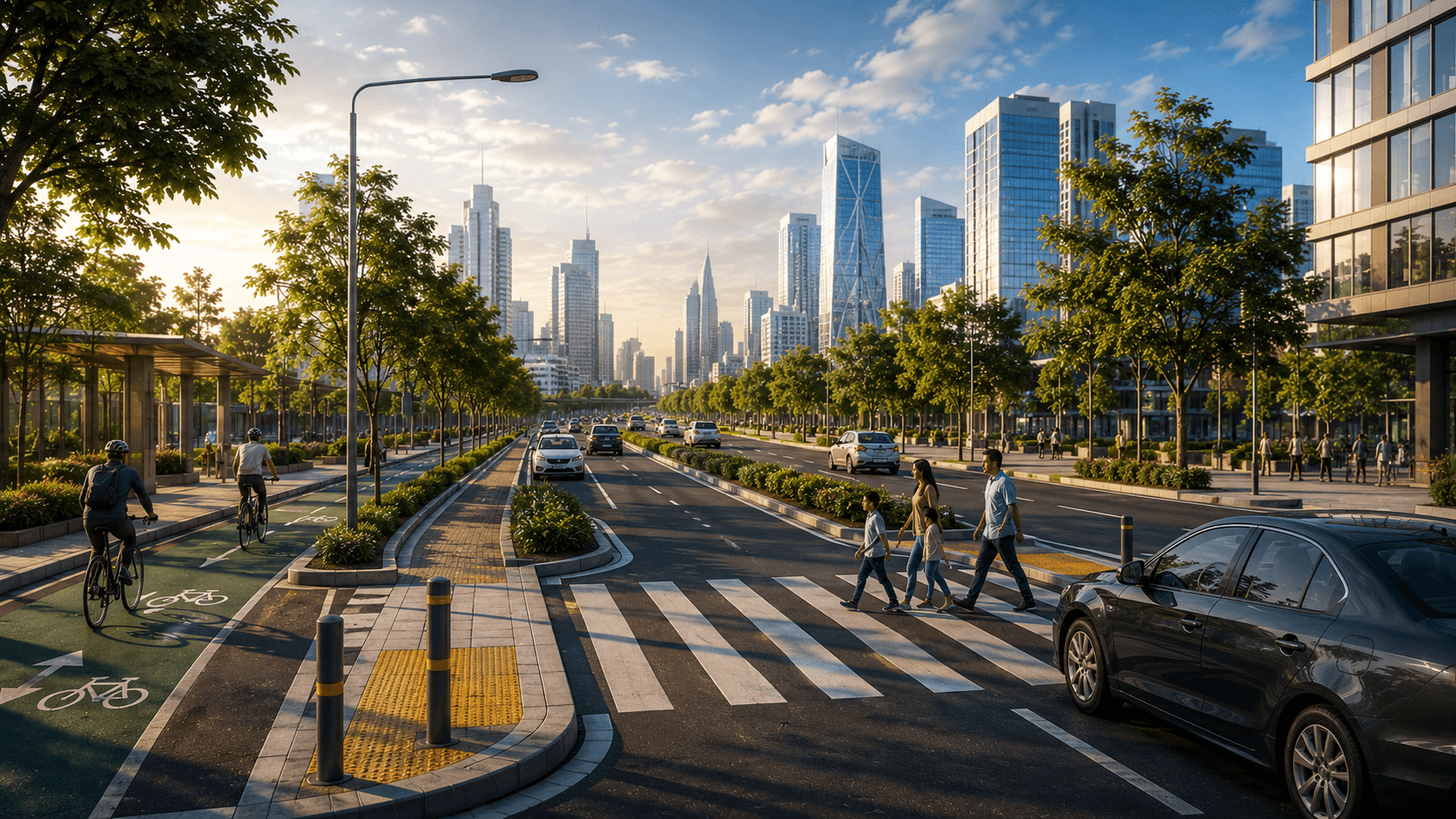
They improve accessibility to employment and education. They strengthen economic productivity. They enhance road safety. They encourage sustainable travel. They reduce environmental impacts. They improve emergency response times. They create more attractive places to live, work, and invest.
In this sense, traffic modelling becomes an investment in urban resilience rather than simply a design exercise.
A New Era of Transportation Engineering
The transportation industry is evolving at an extraordinary pace. Artificial Intelligence is accelerating data analysis. Digital Twins are transforming infrastructure management. Connected vehicles are changing travel behaviour. Smart intersections are optimising traffic flow in real time.
Tomorrow's engineers will spend less time collecting data and more time interpreting complex mobility systems. Rather than replacing engineers, technology is expanding what engineers can achieve.
Why Integrated Thinking Matters
Transportation challenges rarely exist in isolation. A new development may require:
- Transport Planning
- Traffic Impact Studies
- Parking Design
- Traffic Modelling
- Road Safety Assessments
- Temporary Traffic Management
- Independent Technical Reviews
Treating each discipline separately often leads to fragmented solutions. The most successful projects adopt an integrated approach where planning, engineering, modelling, safety, and operations work together from the earliest stages of development.
Final Thoughts
Traffic modelling and simulation are often described as technologies that predict the future. In reality, they do something even more valuable. They help create a better one.
By allowing engineers to evaluate infrastructure before it is built, compare alternative solutions, and understand long-term operational performance, traffic modelling supports decisions that improve mobility for generations to come.
As cities continue to grow and transportation networks become increasingly interconnected, the ability to visualise tomorrow's traffic before construction begins will become one of the defining capabilities of modern transportation engineering.
The future belongs to organisations that do more than analyse traffic. It belongs to those that understand how mobility shapes economies, communities, and the everyday lives of millions of people.
Because the most successful transportation projects are not those that simply move more vehicles. They are the ones that move people more safely, more efficiently, and more sustainably.
About Aurelion Traffic Solutions
Aurelion Traffic Solutions is a specialist transportation engineering consultancy delivering Traffic Modelling & Simulation, Transport Planning, Traffic Impact Studies, Parking Design, Road Safety Engineering, Temporary Traffic Management, and Specialist Advisory services across the UAE and GCC. By combining advanced analytical technologies with multidisciplinary engineering expertise, we help governments, developers, engineering consultants, and infrastructure owners make confident decisions that improve mobility, enhance road safety, and support sustainable infrastructure development.