Road Safety
Good Roads Move Traffic. Great Roads Save Lives.
Why Road Safety Engineering Is More Important Than Ever
By Aurelion Traffic Solutions
Part 1 – Safety Is Designed, Not Discovered
Every day, millions of journeys begin with a simple expectation.
People expect to reach home safely. Parents expect their children to cross roads safely on their way to school. Businesses expect goods to reach their destinations without incident. Emergency services expect reliable access when every second matters.
These expectations seem ordinary because most of us rarely think about the engineering that makes them possible.
Yet every road, intersection, pedestrian crossing, roundabout, cycle lane, and traffic signal represents hundreds of engineering decisions that directly influence human safety.
Road safety is not simply the absence of accidents. It is the result of careful planning, intelligent engineering, and a deep understanding of how people interact with transportation infrastructure.
Good roads certainly move traffic efficiently. Great roads do something even more important. They save lives.
Road Safety Begins Long Before Construction
Many people associate road safety with speed limits, traffic enforcement, or driver behaviour. While these factors are important, the greatest opportunity to improve safety often exists much earlier—during planning and design.
Before the first layer of asphalt is placed, transportation engineers make decisions that influence how safely a road will operate for decades. Questions such as:
- Is the intersection easy to understand?
- Will drivers have sufficient visibility?
- Are pedestrians protected?
- Is there enough time to react?
- Can cyclists move safely?
- Is emergency access maintained?
- Will heavy vehicles operate safely?
- Could drivers make unexpected manoeuvres?
The most effective safety improvements are therefore those incorporated into the design itself.
Understanding Human Behaviour
One of the biggest shifts in modern road safety engineering is recognising that roads should be designed for real people—not ideal drivers.
People become distracted. People become tired. People misjudge speed. People make mistakes.
Modern road safety engineering recognises a different reality. Mistakes are inevitable. Infrastructure should therefore minimise the consequences of those mistakes whenever possible.
Instead of asking "How can we stop people making mistakes?" engineers increasingly ask "How can we design roads that remain safe when mistakes happen?"
This seemingly simple shift has influenced everything from junction design and lane widths to pedestrian crossings, roadside barriers, and speed management.
The Safe System Approach
Around the world, transportation authorities are increasingly adopting what is known as the Safe System Approach.
The principle is simple. Human error cannot be completely eliminated. Serious injuries and fatalities, however, can be significantly reduced through better infrastructure, safer vehicles, responsible road users, appropriate operating speeds, and effective post-crash response.
Engineering plays one of the most important roles within this system. Well-designed infrastructure reduces conflict points, improves visibility, encourages appropriate driving behaviour, separates incompatible traffic movements, provides recovery space, and protects vulnerable road users.
Road Safety Is an Investment
Some organisations still view road safety improvements as additional project costs. In reality, they represent one of the most valuable long-term investments available.
Safer roads generate benefits that extend far beyond reducing collisions. They improve:
- Public confidence
- Community wellbeing
- Emergency response
- Network reliability
- Traffic flow
- Economic productivity
- Asset longevity
- Urban liveability
Every avoided collision represents fewer injuries, less disruption, lower healthcare costs, greater confidence in public infrastructure, and improved quality of life. These benefits continue throughout the life of the infrastructure.
Every Project Has Safety Risks
Road safety engineering is relevant to almost every transportation project. Examples include:
- New highways
- Urban streets
- Residential communities
- Mixed-use developments
- School zones
- Hospitals
- Industrial developments
- Airports
- Logistics facilities
- Public transport corridors
Each environment introduces different operational risks. Road safety engineering adapts to each context while maintaining one consistent objective: Creating transportation systems that protect every road user.
Safety Is Measured Before the First Vehicle Arrives
One of the greatest strengths of modern road safety engineering is that risks can often be identified before infrastructure opens.
Rather than waiting for collisions to occur, engineers evaluate designs during planning, preliminary design, detailed design, construction, and post-opening stages. This proactive approach allows hazards to be removed before they become real-world problems.
This is why today's safest roads are rarely the result of chance. They are the result of deliberate engineering.
Beyond Compliance
Meeting engineering standards is essential. But compliance alone does not automatically produce safe infrastructure.
The difference often lies in engineering judgement. Experienced road safety engineers evaluate how infrastructure will actually be used. They consider driver expectations, visibility, conflict points, operational behaviour, future growth, maintenance, environmental conditions, and construction staging.
These practical considerations transform a technically compliant design into one that is genuinely safe.
Looking Ahead
Road safety engineering is changing rapidly. Artificial Intelligence is identifying near-miss incidents before collisions occur. Connected infrastructure is improving traffic management. Digital Twins are helping engineers evaluate safety improvements before implementation. Data analytics are revealing hidden risk patterns that traditional methods often miss.
But regardless of how technology evolves, one principle remains unchanged. Every engineering decision has the potential to protect lives. And that responsibility makes road safety engineering one of the most important disciplines in modern transportation.
Part 2 – Finding Risks Before They Become Accidents
One of the greatest misconceptions about road safety is that it begins after accidents occur.
In reality, the most effective safety improvements happen long before the first vehicle uses a road. Modern road safety engineering is proactive rather than reactive. Instead of waiting for collision statistics to reveal problems, engineers systematically evaluate potential risks during planning, design, construction, and operation.
The objective is simple: Identify hazards before road users encounter them.
What Is Road Safety Engineering?
Road safety engineering is the discipline of analysing, designing, and improving transportation infrastructure to reduce the likelihood and severity of crashes.
It considers how infrastructure influences behaviour and asks questions such as:
- Is the road easy to understand?
- Are conflict points minimised?
- Can drivers react in sufficient time?
- Are pedestrians clearly visible?
- Can cyclists travel safely?
- Are heavy vehicles accommodated appropriately?
- Does the design encourage safe speeds?
The Importance of Road Safety Audits
A Road Safety Audit is an independent and systematic review of a transportation project carried out by qualified professionals who are not directly involved in the design.
Its purpose is not to verify compliance with design standards. Its purpose is to identify potential safety risks that may affect future road users.
A road can fully comply with engineering standards while still presenting avoidable safety concerns. Road Safety Audits therefore provide an independent perspective that complements the design process rather than replacing it.
Road Safety Throughout the Project Lifecycle
Road Safety Audits are not limited to completed roads. They can provide value at multiple stages of project development.
Planning Stage: At the earliest stage, engineers assess whether proposed road layouts, access arrangements, and land-use interactions could create future safety concerns.
Preliminary Design: As geometric layouts become more detailed, engineers evaluate intersection configurations, visibility, lane arrangements, pedestrian facilities, cycling infrastructure, access management, and traffic control concepts.
Detailed Design: Detailed Road Safety Audits examine engineering drawings, signage, pavement markings, lighting, roadside features, drainage, barriers, and other operational elements.
Construction: Temporary traffic arrangements also require careful consideration. Road safety engineers review Temporary Traffic Management Plans to protect drivers, construction workers, pedestrians, cyclists, public transport users, and emergency services.
Post-Construction: Even after a road opens, safety engineering continues. Operational reviews help identify opportunities for further improvement based on real-world traffic conditions.
Understanding Collision Analysis
Every collision tells a story. Not simply about what happened. But about why it happened.
Collision analysis is one of the most important components of road safety engineering because it seeks to identify underlying causes rather than isolated events. Engineers examine patterns such as:
- Collision frequency
- Severity
- Location
- Time of day
- Weather conditions
- Road geometry
- Traffic control
- Vehicle types
- Driver behaviour
When these patterns are analysed collectively, they often reveal recurring issues. Repeated rear-end collisions may indicate inadequate signal coordination. Frequent side-impact crashes may suggest poor sight distance. Pedestrian incidents could highlight inadequate crossing facilities.
By understanding these patterns, engineers can recommend targeted improvements that address root causes instead of symptoms.
Designing for Every Road User
Modern transportation systems must serve a diverse range of users with different needs and varying levels of vulnerability. Road safety engineering therefore extends far beyond motor vehicles.
Pedestrians: Safe crossings, accessible footpaths, reduced crossing distances, adequate lighting, clear visibility, barrier-free movement.
Cyclists: Protected facilities, conflict reduction at intersections, clear lane continuity, safe overtaking opportunities, improved visibility.
Public Transport Users: Safe bus stop locations, convenient pedestrian connections, passenger waiting areas, accessible boarding facilities, reduced interaction with general traffic.
Freight Vehicles: Appropriate turning radii, loading access, vehicle manoeuvrability, conflict management with vulnerable users, operational efficiency.
Emergency Services: Reliable access, adequate road widths, efficient intersection operation, rapid response routes, maintaining emergency access during both normal operation and construction activities.
Engineering for Human Error
One principle increasingly influences every aspect of road safety engineering: People will make mistakes.
Rather than expecting perfect behaviour, engineers design infrastructure that reduces the consequences of inevitable human error. Examples include:
- Roundabouts that reduce severe conflict points
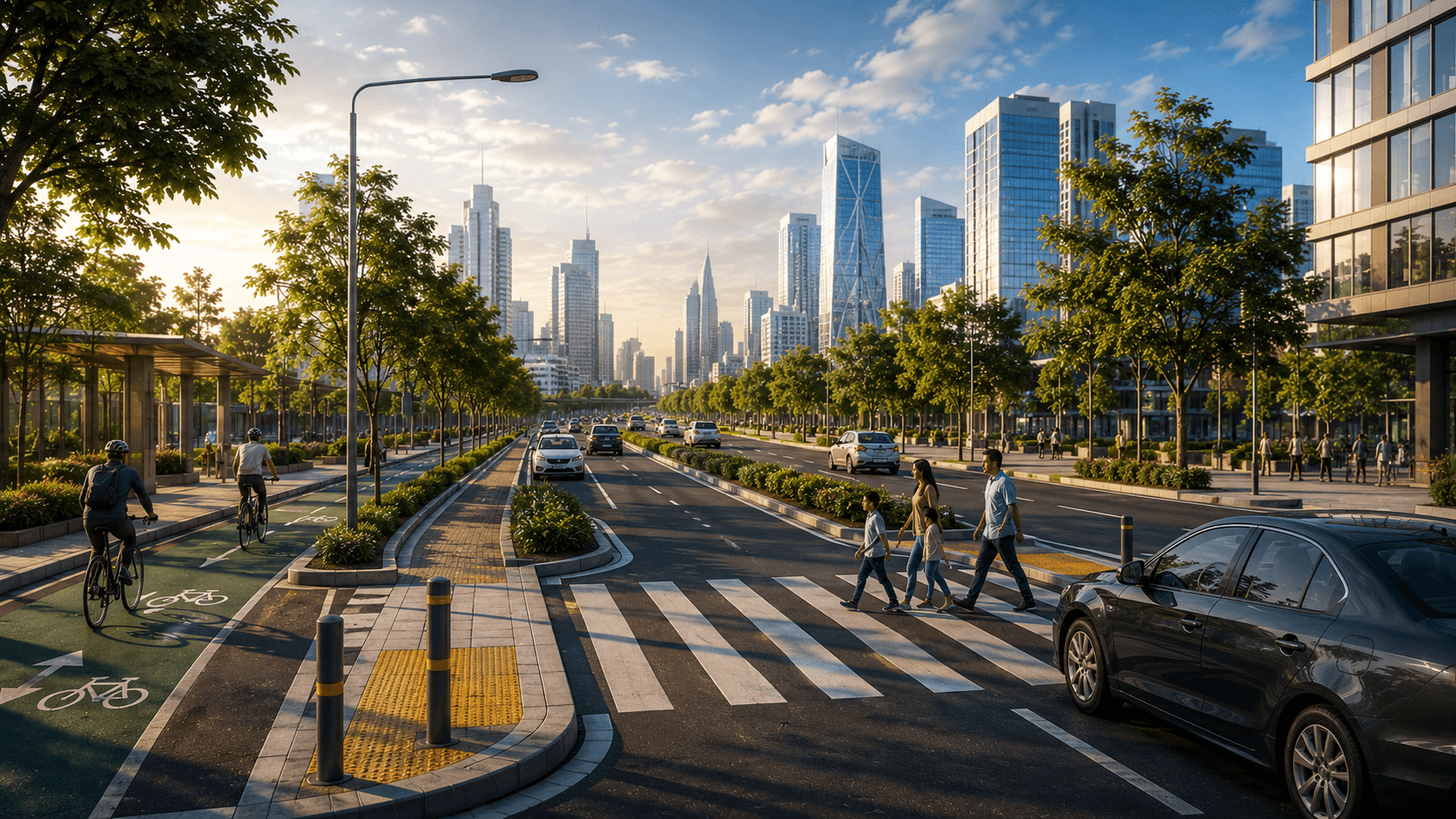
- Refuge islands that shorten pedestrian crossings
- Median barriers that prevent head-on collisions
- Forgiving roadsides that minimise crash severity
- Clear wayfinding that reduces sudden manoeuvres
- Consistent road layouts that improve driver expectations
This philosophy does not encourage unsafe behaviour. Instead, it recognises human limitations and creates transportation environments that remain safer even when mistakes occur.
Safety and Mobility Can Work Together
A common misconception is that improving safety automatically reduces traffic efficiency. In reality, the opposite is often true.
Roads with fewer conflicts, clearer layouts, and more predictable traffic behaviour typically operate more efficiently. Drivers make better decisions. Traffic flows more smoothly. Emergency incidents decrease. Delays are reduced. Public confidence increases.
The best transportation systems therefore balance safety and operational performance rather than treating them as competing objectives.
About Aurelion Traffic Solutions
Aurelion Traffic Solutions is a specialist transportation engineering consultancy delivering Road Safety Engineering, Traffic Impact Studies, Transport Planning, Traffic Modelling & Simulation, Temporary Traffic Management, and Specialist Advisory services across the UAE and GCC. Our multidisciplinary team combines engineering expertise, advanced technology, and practical experience to create safer, smarter, and more sustainable transportation infrastructure.