Transport Planning
Designing Cities That Move
How Transport Planning Is Shaping the Future of the UAE
By Aurelion Traffic Solutions
Part 1: The Foundation of Every Great City
If you ask someone what makes a great city, they might mention its skyline, iconic architecture, efficient airports, or vibrant public spaces. Few people would immediately think about transport planning.
Yet behind every successful city lies something far less visible but far more influential—a transportation system that allows people, goods, and services to move safely, efficiently, and sustainably.
Transportation is the invisible framework that supports economic growth, social interaction, and urban development. When mobility works well, businesses thrive, communities become more connected, and cities become more liveable. When it doesn't, congestion, delays, pollution, and safety concerns quickly become barriers to progress.
As the United Arab Emirates continues its transformation into one of the world's most advanced economies, transportation planning has become a strategic priority rather than simply an engineering exercise.
Today's projects are no longer designed solely around roads. They are planned around people, accessibility, sustainability, technology, and future mobility.
Why Transport Planning Matters More Than Ever
Urban development has changed dramatically over the past two decades.
Modern developments are no longer isolated residential communities or standalone office buildings. They are integrated destinations that combine residential living, commercial activity, education, healthcare, hospitality, retail, recreation, and public transport within the same urban environment.
This complexity creates an important question: How do thousands—or sometimes hundreds of thousands—of daily journeys move efficiently through a development without overwhelming the surrounding transportation network?
The answer begins with transport planning.
Transport planning is the process of understanding how people and goods move today, predicting how they will move tomorrow, and designing transportation systems that continue to perform as cities evolve.
Rather than reacting to congestion after roads become overloaded, transport planners anticipate future travel demand long before construction begins. They evaluate travel behaviour, land use, infrastructure capacity, public transport integration, active mobility, parking demand, and network resilience to develop transportation strategies that support long-term growth.
It is this proactive approach that separates successful developments from those that struggle with congestion, accessibility issues, and costly infrastructure upgrades after completion.
The UAE's Vision for Future Mobility
Few countries have embraced transportation innovation as rapidly as the United Arab Emirates.
Across Dubai, Abu Dhabi, Sharjah, and the Northern Emirates, governments continue to invest heavily in infrastructure that supports economic diversification, sustainable growth, and improved quality of life.
Major investments are extending far beyond traditional road construction. They include:
- Integrated public transport systems
- Metro and rail expansion
- Intelligent Transport Systems (ITS)
- Smart traffic management
- Active mobility networks
- Transit-Oriented Developments (TOD)
- Sustainable transport initiatives
- Artificial intelligence for traffic operations
- Connected infrastructure
- Digital mobility platforms
These initiatives reflect a broader shift in thinking. Cities are no longer measured simply by the number of roads they build. They are increasingly measured by how efficiently they move people.
This philosophy aligns closely with national strategies that prioritise sustainability, innovation, digital transformation, and enhanced urban liveability.
Moving Beyond Road Capacity
Historically, transportation planning often focused on one objective: Increase road capacity.
While capacity remains important, modern transport planning recognises that adding more roads alone cannot solve long-term congestion.
Instead, planners now consider a much broader range of mobility solutions. Questions include:
- Can public transport reduce private vehicle dependency?
- How can pedestrians move safely between destinations?
- Is cycling a practical option?
- Can travel demand be managed more effectively?
- How should parking be planned?
- How will emerging mobility technologies influence travel behaviour?
- What happens as autonomous and connected vehicles become more common?
This broader perspective transforms transport planning from a traffic-focused discipline into a comprehensive mobility strategy. It is no longer about designing roads. It is about designing connected communities.
Transport Planning Begins Long Before Construction
One of the most common misconceptions is that transport planning begins once roads are designed. In reality, it begins much earlier.
Long before the first drawing is prepared, transport planners evaluate questions that influence the entire development. For example:
- Is the proposed location suitable for the intended land use?
- Can the surrounding network accommodate future traffic demand?
- Will existing intersections require upgrades?
- How should different land uses interact?
- Is public transport accessible?
- Are walking and cycling practical?
- How should emergency vehicles access the site?
- What parking strategy best supports the development?
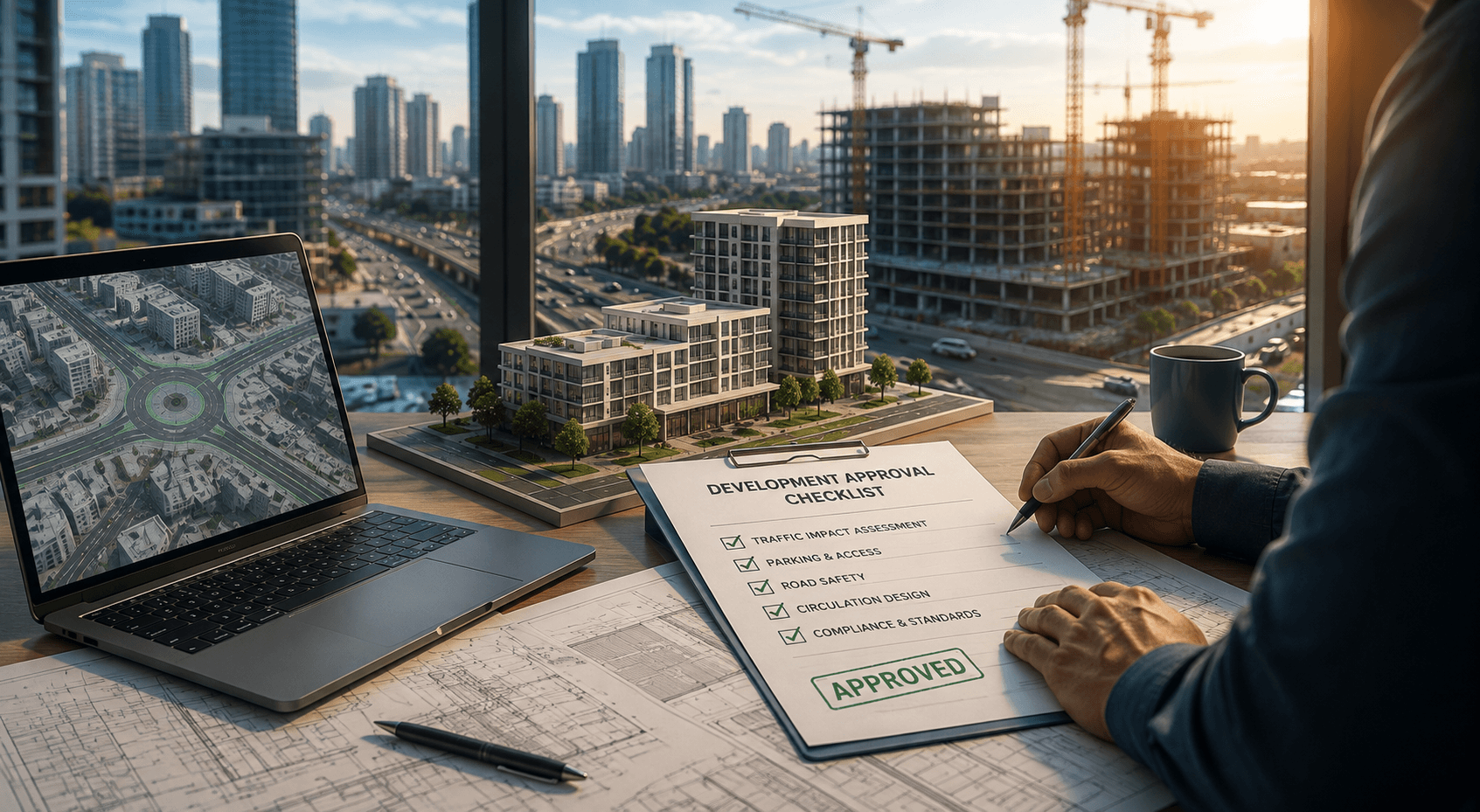
The answers to these questions shape everything that follows. Well-considered transport planning reduces project risk, improves authority approvals, supports better engineering decisions, and ultimately creates developments that remain successful throughout their lifecycle.
Planning Cities for People
Perhaps the biggest change in modern transportation engineering is a simple shift in perspective. For decades, cities were often planned around vehicles. Today, successful cities are increasingly planned around people.
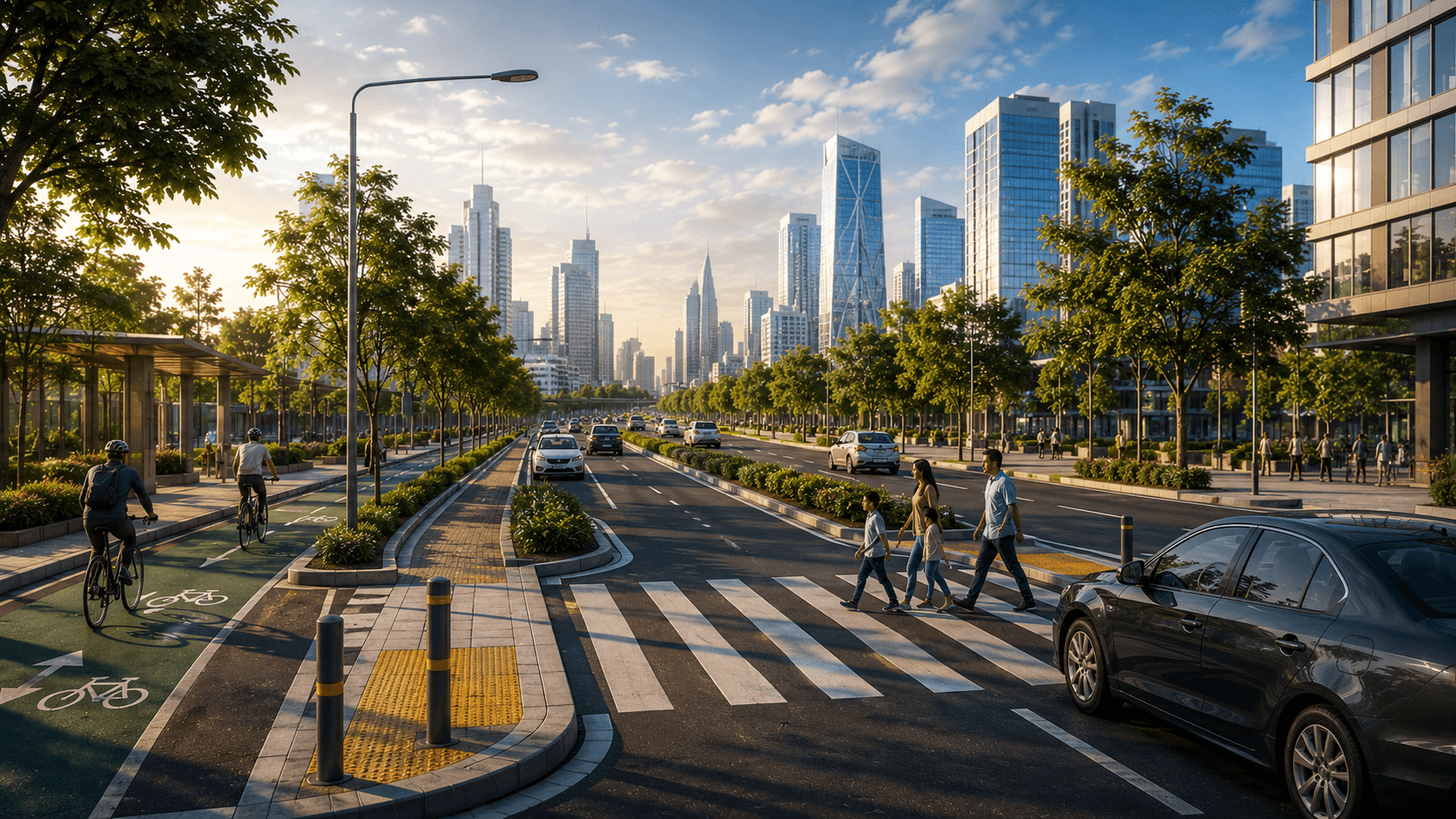
This means creating transportation systems that are safe, inclusive, accessible, and adaptable for everyone—whether travelling by car, public transport, bicycle, or on foot.
Transport planning therefore becomes much more than an engineering discipline. It becomes a tool for improving quality of life.
It influences where people choose to live, how businesses operate, how communities interact, and how future generations experience the cities we build today.
And that is why transport planning is no longer just about moving traffic. It is about shaping the future of cities.
Part 2: The Six Pillars of Modern Transport Planning
If transport planning once revolved around forecasting traffic volumes and designing wider roads, today's reality is very different. Modern transport planning has evolved into a multidisciplinary field that combines engineering, urban planning, technology, environmental sustainability, behavioural science, and economics.
For a rapidly growing nation like the UAE, where ambitious developments continue to reshape the urban landscape, this integrated approach has become essential. Successful transport planning today rests on six interconnected pillars.
1. Planning for People, Not Just Vehicles
The first and perhaps most significant shift in transport planning is the move from vehicle-focused design to people-focused mobility. Modern planning recognises that cities exist for people—not cars.
This means considering every type of road user, including:
- Drivers
- Public transport passengers
- Pedestrians
- Cyclists
- People with disabilities
- Emergency services
- Delivery and freight operators
The most successful developments integrate mobility rather than prioritising a single mode of transport.
2. Integrating Land Use with Transportation
One of the fundamental principles of transport planning is that land use and transportation are inseparable. Every development generates movement.
Transport planners evaluate these travel patterns before development begins to ensure that the surrounding infrastructure can support future activity. This integration allows planners to answer critical questions such as:
- Is the proposed access location appropriate?
- Can nearby intersections accommodate future traffic?
- Is sufficient parking provided?
- How will pedestrians safely move through the site?
- Can public transport effectively serve the development?
- How will future expansion influence mobility?
3. Creating Multimodal Transportation Networks
One of the defining characteristics of modern cities is transportation choice. People increasingly expect multiple ways to travel depending on purpose, distance, convenience, and personal preference.
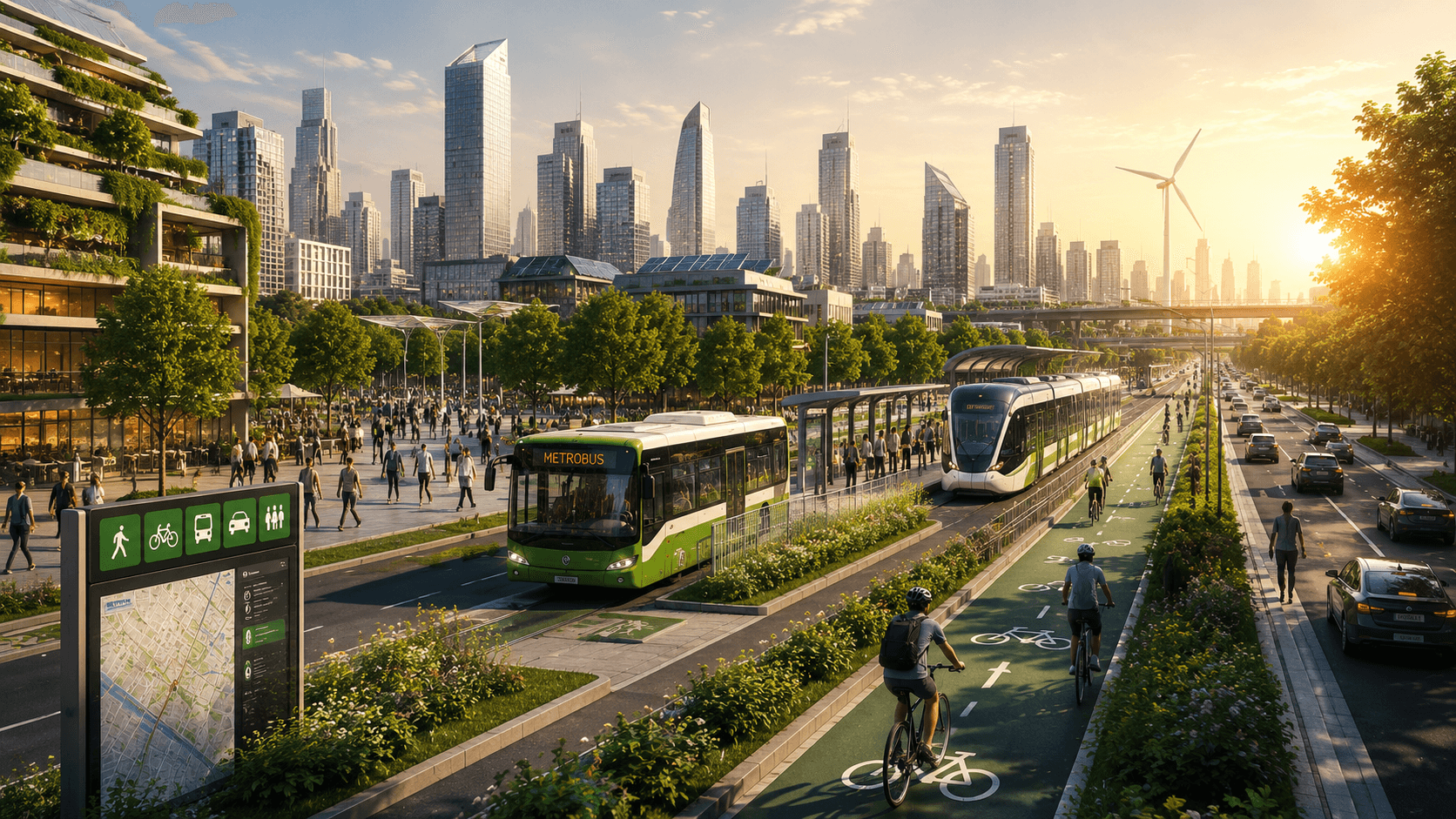
Rather than relying exclusively on private vehicles, successful developments encourage movement through a combination of:
- Private vehicles
- Public transport
- Walking
- Cycling
- Shared mobility
- Future autonomous transport
The role of transport planning is to make these transitions seamless. This improves accessibility while reducing congestion and increasing network resilience.
4. Building Sustainable Mobility
Sustainability is no longer an optional consideration within transportation planning. Transport planning contributes directly to sustainability objectives by reducing unnecessary travel, encouraging efficient transport choices, improving accessibility, and supporting lower-emission mobility.
Examples include:
- Integrated public transport
- Active travel networks
- Mixed-use developments
- Efficient parking strategies
- Reduced vehicle dependency
- Electric vehicle infrastructure
- Smart traffic management
Sustainable mobility does not mean discouraging vehicle use. Instead, it means providing people with realistic alternatives while ensuring road infrastructure continues to operate efficiently.
5. Data-Driven Decision Making
Modern transport planning depends on one critical resource: Reliable data.
Transport planners analyse information collected through numerous sources, including:
- Traffic surveys
- Automatic traffic counters
- Video analytics
- GPS movement data
- Public transport statistics
- Parking utilisation studies
- Land use information
- Population forecasts
- Origin-Destination studies
Data allows multiple development scenarios to be evaluated before construction begins, reducing uncertainty and improving investment decisions.
6. Technology Is Transforming Transport Planning
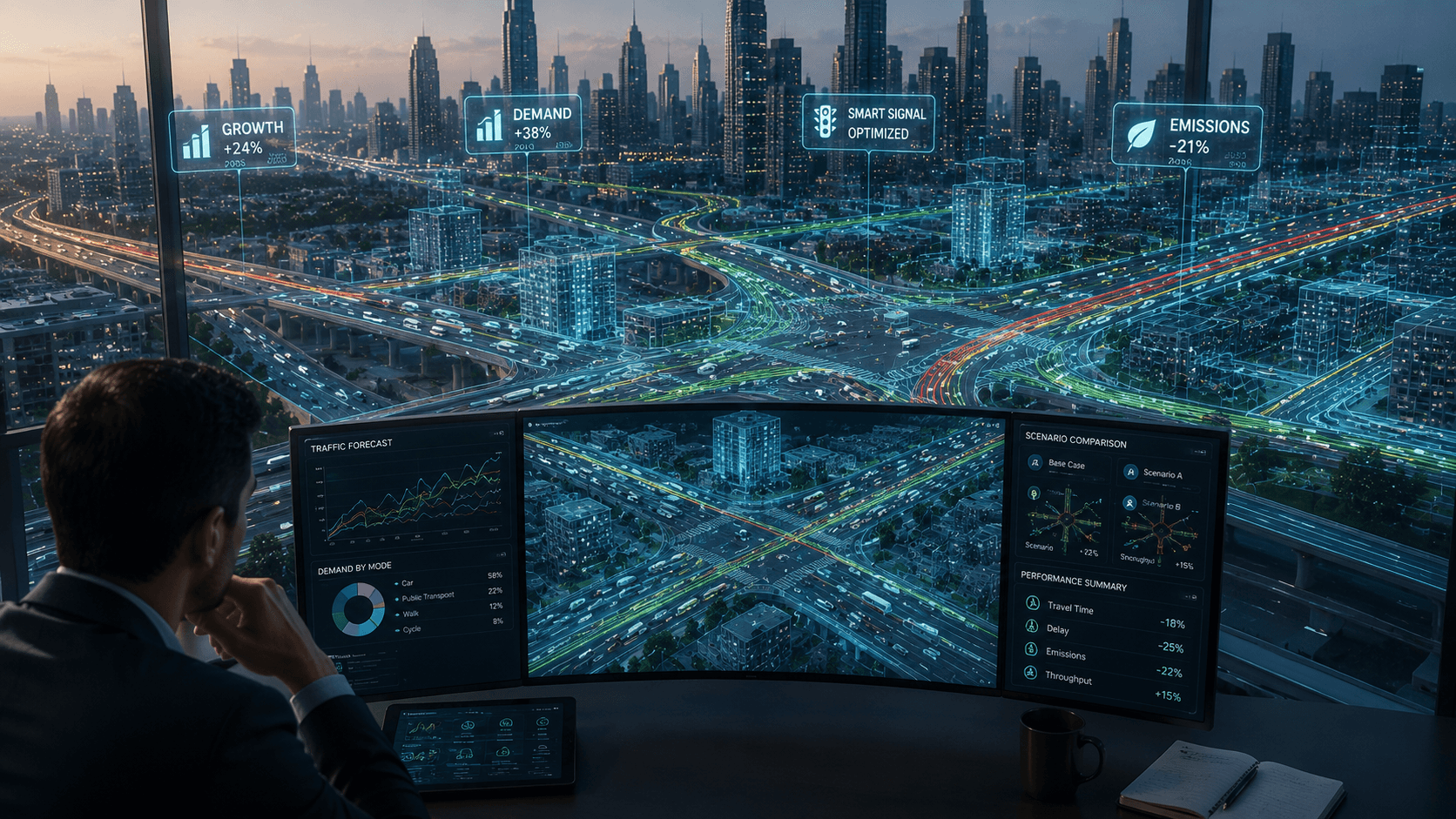
Sophisticated modelling platforms now enable engineers to simulate years of future traffic growth within minutes. Artificial intelligence is accelerating traffic data processing. Geographic Information Systems allow planners to visualise entire transport networks spatially.
Increasingly, transport planning is supported by technologies such as:
- Traffic microsimulation
- Strategic transport modelling
- GIS analytics
- AI-assisted video analytics
- Digital traffic surveys
- Predictive modelling
- Interactive reporting platforms
Technology does not replace engineering expertise. Instead, it enables engineers to evaluate more options, understand complex transport systems more effectively, and deliver recommendations with greater confidence.
Part 3: From Vision to Reality — Building the Cities of Tomorrow
The true value of transport planning is measured not by reports or models, but by how successfully people move through a city years after construction is complete.
As cities across the UAE continue to evolve, transport planning is no longer reacting to urban growth—it is actively shaping it.
The Challenges Facing Rapidly Growing Cities
Urbanisation brings tremendous opportunities, but it also creates increasingly complex transportation challenges. Without careful planning, cities can quickly experience:
- Increasing traffic congestion
- Longer travel times
- Reduced road safety
- Insufficient parking
- Poor public transport connectivity
- Limited pedestrian accessibility
- Environmental impacts
- Reduced economic productivity
These challenges cannot be solved simply by constructing additional roads. Modern cities require transportation systems that are resilient, adaptable, and capable of supporting growth over decades rather than years.
Transport Planning Across the Development Lifecycle
One of the greatest strengths of transport planning is that it contributes value throughout every stage of a project.
Concept Planning: Long before architectural drawings begin, transport planners evaluate whether the proposed land use is appropriate for its location.
Master Planning: As developments become larger, transport planning evolves from evaluating individual roads to designing complete movement systems.
Detailed Design: Once the overall transport strategy has been established, engineers refine operational details including junction layouts, signal coordination, access design, and pedestrian crossings.
Construction: Temporary Traffic Management Plans help maintain mobility while construction progresses safely.
Operations: Monitoring traffic performance allows engineers to evaluate whether transportation systems are operating as intended.
The Rise of Smart Mobility
Transportation is becoming increasingly intelligent. Cities are embracing technologies that continuously monitor, analyse, and optimise transport systems. Examples include:
- AI-powered traffic cameras
- Connected traffic signals
- Smart parking systems
- Public transport tracking
- Predictive congestion analysis
- Integrated control centres
- Digital mobility platforms
Instead of reacting after congestion develops, operators can anticipate traffic conditions and implement improvements proactively.
Artificial Intelligence Is Changing Transportation Engineering
Modern AI platforms can process enormous quantities of transportation data within minutes. Applications include:
- Automatic vehicle classification
- Pedestrian detection
- Queue length estimation
- Turning movement analysis
- Speed monitoring
- Near-miss detection
- Travel pattern analysis
- Incident identification
AI does not replace transportation engineers. Instead, it removes repetitive data-processing tasks, allowing engineers to focus on interpreting results and developing practical engineering solutions.
Digital Twins: Testing Tomorrow Before It Happens
A Digital Twin is a dynamic digital representation of a physical transportation system. Engineers can test population growth, new developments, road upgrades, public transport expansion, policy changes, emergency situations, major events, and climate impacts—all before construction begins.
This significantly reduces uncertainty while helping governments and developers make better long-term investment decisions.
Part 4: The Road Ahead — Engineering the Future of Mobility
Cities have always evolved alongside transportation. Today, the UAE stands at another defining moment in that journey.
Across the country, governments are investing not only in infrastructure, but in creating smarter, more connected, and more sustainable cities. Transportation is no longer viewed as a supporting function—it has become one of the primary drivers of economic growth, urban resilience, environmental sustainability, and quality of life.
From Infrastructure to Intelligent Mobility
Success will increasingly depend on questions such as:
- How efficiently can people move between destinations?
- How well are different transport modes integrated?
- Can infrastructure adapt to changing travel patterns?
- How resilient is the transportation network during disruption?
- How sustainable are mobility choices?
- How effectively is technology supporting decision-making?
The role of transport planning is expanding beyond engineering design. It is becoming a strategic discipline that shapes how cities function for decades to come.
Collaboration Is the Future of Transportation Engineering
A successful transportation project requires architects, urban planners, transport planners, traffic engineers, road safety specialists, environmental consultants, infrastructure designers, digital technology experts, and government authorities to work together from the earliest planning stages.
Rather than designing roads independently and addressing transport issues later, multidisciplinary teams develop integrated solutions where land use, mobility, infrastructure, sustainability, and community needs are considered together.
Data Will Drive Every Major Decision
The next generation of transportation planning will be increasingly data-driven. Planners will have access to continuous streams of information generated by connected infrastructure, intelligent transport systems, sensors, AI-powered analytics, and digital mobility platforms.
Rather than asking "Why did congestion occur?" engineers will increasingly ask "Where is congestion likely to occur tomorrow—and how can we prevent it today?"
However, technology alone is not enough. The greatest value comes from combining advanced digital tools with experienced engineering judgement. Data identifies opportunities. Engineers determine the most effective solutions.
The Human Side of Mobility
Amid discussions of artificial intelligence, digital twins, autonomous vehicles, and smart infrastructure, it is easy to forget one important fact. Transportation has always been about people.
A safer intersection means children can walk to school with greater confidence. A better public transport connection shortens a commuter's journey home. A well-designed cycle path encourages healthier lifestyles. An efficiently planned logistics corridor supports businesses and strengthens the economy.
The true purpose of transport planning is not simply to improve traffic. It is to improve lives.
The Opportunity for Developers and Infrastructure Owners
Projects that integrate transportation planning early often benefit from:
- Better development outcomes
- More efficient access arrangements
- Improved parking performance
- Stronger connectivity
- Reduced operational risks
- Greater long-term flexibility
- Better user experience
- Increased commercial value
In both cases, good transport planning creates value long after construction has finished.
Final Thoughts
Transport planning is often invisible when it succeeds—but its impact is felt every day.
From the moment a person leaves home until they reach their destination, countless engineering decisions influence the safety, efficiency, and reliability of that journey.
As the UAE continues building world-class communities and globally connected cities, transport planning will remain one of the foundations of sustainable urban development.
By integrating engineering expertise, digital technology, data-driven analysis, and long-term strategic thinking, transport planners help create places that are not only easier to move through but also better to live, work, and invest in.
Ultimately, great cities are not remembered for the roads they build. They are remembered for how effortlessly they connect people, opportunities, and possibilities.
About Aurelion Traffic Solutions
Aurelion Traffic Solutions is a specialist transportation engineering consultancy based in Dubai, delivering integrated services across Transport Planning, Traffic Impact Studies, Traffic Modelling & Simulation, Road Safety Engineering, Temporary Traffic Management, and Specialist Advisory. Combining engineering expertise with advanced digital technologies, we help governments, developers, engineering consultants, and infrastructure owners deliver safer, smarter, and more sustainable mobility solutions across the UAE, GCC, and international markets.